Car Won’t Start? Dead Battery, Alternator or Starter: How to Tell
When a car won’t start, the sound it makes usually points to the cause: rapid clicking or dim lights often mean a weak battery, a single click with bright lights often points to the starter, and a car that starts after a jump but dies again soon after often has an alternator problem. Here is how to tell them apart, what you can safely check yourself, and when to call for a jump start or a tow.
Quick answer
- Rapid clicking, dim dash lights or nothing at all: most likely a weak or dead battery.
- One loud click, bright lights, no crank: often the starter or its connection.
- Starts with a jump, then dies or the battery light comes on while driving: often the alternator.
- Engine cranks normally but won’t fire up: usually fuel, ignition or a security issue, not the battery.
- A jump start helps with a battery problem. It usually won’t fix a bad starter or alternator for long.
- Not sure? Call All Wide Towing & Recovery at (757) 796-4622 and describe what you hear.
What does each symptom usually mean?
The quickest way to narrow it down is to turn the key or press the start button once and pay close attention to what happens.
- Rapid clicking: the battery has enough power to trip the starter relay but not enough to turn the engine. This is the classic weak battery sign.
- No sound, no lights: the battery may be fully drained, or a terminal may be loose or badly corroded.
- Dim or flickering lights: low battery voltage, from a drained battery or a charging system that isn’t keeping up.
- One solid click, lights stay bright: the battery seems fine, so the starter motor, starter solenoid or its wiring is a likely suspect.
- Cranks but won’t start: the starter and battery are doing their jobs. Look at fuel, spark or the anti-theft system instead.
- Starts, then dies: after a jump, this often points to the alternator not recharging the battery.
- Battery warning light while driving: usually a charging problem, such as the alternator or its belt, rather than the battery itself.
How do I know if it’s a dead battery?
A dead or weak battery is the most common reason a car won’t start, and it’s also the easiest to fix on the spot.
Common signs: slow, labored cranking; rapid clicking; dim headlights and dash lights; or a car that was fine yesterday and is completely silent today.
Simple safe checks:
- Turn on the headlights without starting the car. If they’re dim or fade fast, the battery is low.
- Look at the battery terminals without touching them. White, green or blue crust means corrosion that can block current.
- Think about the battery’s age. Most car batteries last a few years, and an older battery fails more easily in hot or cold weather.
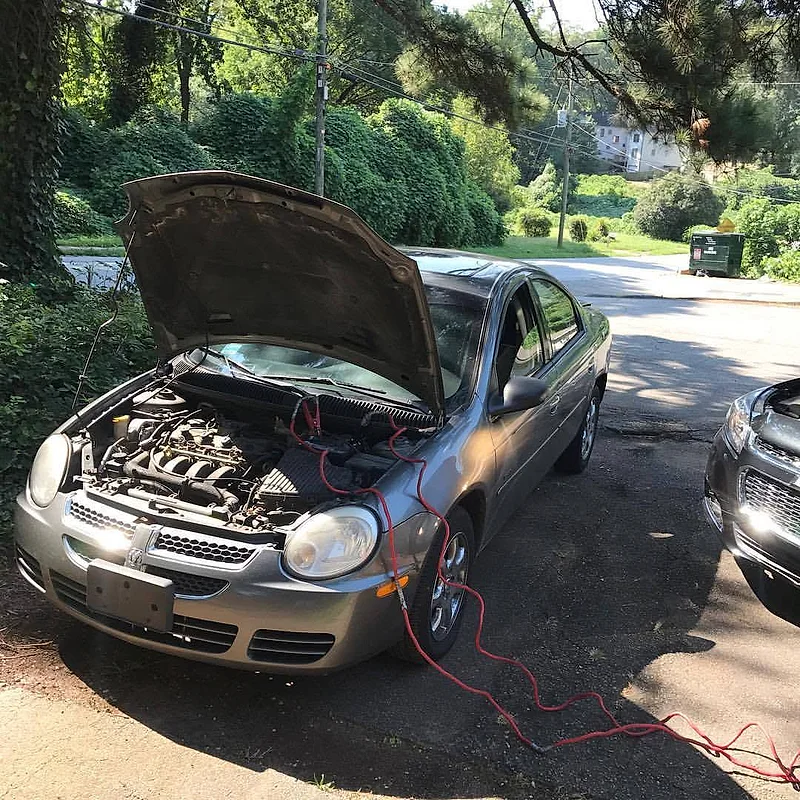
When a jump start helps: almost always, as long as the battery isn’t damaged. A jump gets you running, and a good drive gives the alternator a chance to recharge it.
When it won’t: if the battery is cracked, leaking, swollen or won’t hold a charge at all, a jump won’t solve it. The battery needs to be replaced.
How do I know if it’s the alternator?
The alternator charges your battery while the engine runs, so a failing alternator often looks like a battery problem that keeps coming back.
Common signs: a battery or charging warning light on the dash, headlights that dim and brighten as you drive, a whining or growling noise from the engine, or a car that starts after a jump and then stalls within minutes.
Simple safe checks:
- Note whether the battery light came on while you were driving before the car quit.
- After a jump, watch the dash lights with the engine running. If they keep dimming, the alternator may not be charging.
- With the engine off, look for a cracked or missing drive belt. Never reach near the belt while the engine is running.
When a jump start helps: it may get the engine running, but only for a short while, because the car is running on whatever charge the battery has left.
When it won’t: if the car dies again soon after a jump, more jumps won’t fix it. That’s the time to tow it to a shop rather than risk stalling in traffic.
How do I know if it’s the starter?
The starter is the small motor that spins your engine to get it going, and when it fails you’ll usually hear a click with no crank while the lights stay bright.
Common signs: a single loud click, a grinding or whirring sound when you turn the key, the starter working some days and not others, or a car that starts only after several tries.
Simple safe checks:
- Turn on the headlights and try to start the car. If the lights stay bright and you hear only a click, the battery probably isn’t the issue.
- Make sure an automatic is fully in Park, or try starting in Neutral. A misaligned shifter can block starting.
When a jump start helps: rarely. If the battery is strong, adding more power won’t turn a worn starter.
When it won’t: a repeated click with bright lights usually means the starter or its wiring needs a mechanic, and the car needs a tow to the shop.
What else can stop a car from starting?
Not every no-start is about the battery, alternator or starter, and a few causes are simple to rule out.
- Fuel: an empty tank or a failing fuel pump can leave the engine cranking without catching.
- Security or immobilizer: a flashing key or lock symbol on the dash can mean the car doesn’t recognize your key. Try a spare key if you have one.
- Key fob battery: a weak fob battery can stop a push-button car from starting. Many owner’s manuals explain how to start the car by holding the fob against the start button or a marked spot.
- Steering lock: if the key won’t turn, gently wiggle the steering wheel while turning the key.
Why Hampton Roads weather is hard on car batteries
Both summer heat and winter cold wear on car batteries, and Hampton Roads gets a good dose of each.
Hot, humid summers speed up the chemical wear inside a battery, so damage often builds up in July and August and then shows up on the first cold winter morning, when a cold engine needs more power to turn over.
Short city trips around Norfolk, Portsmouth and Chesapeake add to it. A few miles to work or the store may not give the alternator enough time to fully recharge the battery.
Cars that sit also lose charge. Around Naval Station Norfolk and the other bases in the region, plenty of vehicles sit parked while their owners are deployed or away for training, and a battery can slowly drain over weeks of sitting. A battery tender can help.
Near the coast, salt air and humidity can speed up corrosion on battery terminals. Checking for crusty buildup now and then is a good habit.
Jump start or tow? How to decide
If the signs point to a weak battery, try a jump start first; if they point to the starter or alternator, plan on a tow.
- Try a jump: rapid clicking, dim lights, a car that sat for a while or lights left on overnight.
- Plan on a tow: a single click with bright lights, a car that died again soon after a jump, a battery light that came on while driving, grinding noises, or any smell of burning or leaking fluid.
- Tow for safety: if you’re stuck on a busy road or highway, getting the car off the road may matter more than getting it running. Our guide on what to do if your car broke down on I-64 or I-264 in Norfolk covers that step by step.
We offer roadside assistance and jump starts and towing service across Hampton Roads. Not sure which you need? Call and describe the symptoms.
Safety notes for jump-starting
Jump-starting is safe when you take a few precautions, and the first one is to follow your owner’s manual.
- Read the jump-starting section of your owner’s manual. Some cars have specific connection points under the hood.
- Never jump a battery that is cracked, leaking, bulging or smells like rotten eggs.
- Turn both cars off and set the parking brakes before connecting cables.
- Keep sparks, flames and cigarettes away from the battery.
- If you aren’t comfortable doing it, call for help rather than guess.
What to tell dispatch
A few clear details help the dispatcher send the right truck and the right equipment the first time.
- Your exact location, including a street address, cross street or nearby landmark
- Year, make, model and color of your vehicle
- What you hear when you try to start it: clicking, one click, grinding, cranking or nothing
- Whether the dash lights come on and whether the battery light was on before it quit
- Where you’d like the car taken if it needs a tow, with the shop’s name and address
Ask for the price before the truck is sent, so there are no surprises.
Frequently asked questions
How can I tell a dead battery vs alternator problem? If the car starts with a jump and keeps running, the battery was likely the issue. If it dies again soon after or the battery light comes on while driving, the alternator is the more likely cause.
Why does my car click but not start? Rapid clicking usually means a weak battery. A single click with bright lights more often points to the starter or a bad connection.
Can a jump start damage my car? When done the way your owner’s manual describes, a jump start is generally safe. Connecting cables in the wrong order or jumping a damaged battery can cause problems.
My car cranks but won’t start. Is it the battery? Usually not. Normal cranking means the battery and starter are working, so fuel, ignition or the security system are more likely.
Can you jump start my car in Norfolk, VA? Yes. We provide jump starts and other roadside help in Norfolk, Chesapeake, Portsmouth and the rest of Hampton Roads.
Need a jump start or a tow in Hampton Roads?
If your car won’t start, All Wide Towing & Recovery can help with a jump start or a tow. Call (757) 796-4622. We’re based in Norfolk and serve Norfolk, Virginia Beach, Chesapeake, Portsmouth, Suffolk, Hampton and Newport News. We’re open every day, day and night, and you can also reach us through our contact page.
Need a tow in Norfolk?
Last updated: