Who Pays for a Tow After a Car Accident in Virginia?
In Virginia, the at-fault driver’s liability insurance generally pays for the other driver’s damages, and that can include towing and storage. Your own collision coverage or a towing add-on may pay first and seek reimbursement later. Either way, you may be asked to pay the tow company up front, so keep your receipt and check your policy with your insurer.
Quick answer
- Virginia is an at-fault (tort) state. The driver who caused the crash is generally responsible for the other driver’s damages, usually through their liability insurance.
- Those damages can include towing and storage, along with the repairs.
- Your own collision coverage, roadside or towing coverage, or an auto club membership may pay for the tow sooner, depending on your policy.
- The tow company usually needs to be paid when the car is towed or picked up, so plan to pay and get reimbursed.
- Keep your receipt, the police report number and your photos.
- Storage fees can add up daily, so move the car to your chosen shop promptly.
- Check your policy and talk to your insurer about what applies to you.
If the other driver was at fault
When another driver causes the crash, their liability insurance is generally responsible for your property damage. In many cases that includes a reasonable tow from the scene and storage while the claim is handled.
That said, the other driver’s insurer doesn’t pay instantly. They usually need to review the claim and accept fault first, which can take some time. Meanwhile, your car still needs to come off the road, and the tow company still needs to be paid.
Many drivers in this spot do one of two things:
- Open a claim with the other driver’s insurer and submit the towing receipt as part of it.
- Use their own collision or towing coverage to get moving faster, and let their own insurer seek repayment from the at-fault driver’s company.
Your insurer can explain which path makes more sense for your situation, including how a deductible might be handled.
If you were at fault or fault is unclear
If you caused the crash, the other driver’s liability claim won’t cover your own car. Your tow may be covered by your own collision coverage or by a roadside or towing add-on, if you have one. If you only carry liability coverage, you may end up paying for your own tow.
Fault isn’t always clear at the scene. Drivers may disagree, and insurance companies sometimes take a while to sort it out. Don’t argue about fault on the roadside, and don’t wait for a decision before getting the car moved. Get it towed to a safe place, keep the paperwork, and let the insurers work it out.
Coverages that can pay for a tow
Depending on your policy and the situation, one or more of these may help with the cost of a tow:
- The other driver’s liability insurance: may pay for towing and storage as part of your property damage when the other driver is at fault.
- Your collision coverage: may pay to tow your damaged car after a crash, often subject to your deductible.
- Roadside assistance or towing coverage: an add-on to many auto policies that may pay for a tow, sometimes up to a set distance or limit.
- Auto club or membership programs: may include a certain number of tows each year.
- Credit card or dealer roadside programs: some cards, new-car warranties and dealers offer roadside help that may cover a tow.
Every policy and program is different. Some only pay if you call their own provider, while others reimburse you after you send a receipt. Check your policy and talk to your insurer before you assume a tow is covered.
Uninsured or hit-and-run
If the at-fault driver has no insurance, or drives away before you can get their information, uninsured motorist coverage on your own policy may help pay for your damages. In some cases that can include towing. Your collision coverage may also apply.
For a hit-and-run, call the police and report it as soon as you can. Your insurer will likely ask for the police report number, and photos of the damage and the scene help too. Write down anything you remember about the other vehicle, such as its color, type, and any part of the plate.
Paying out of pocket and getting reimbursed
Even when someone else should ultimately pay, you’ll often be the one paying the tow company at the time of service. That’s normal. The key is to keep good records so you can get the money back.
- Ask for an itemized receipt that lists the tow, any extra work and any storage.
- Write down the police report number, or ask how to get a copy of the crash report.
- Take photos of the damage and the scene, as long as it’s safe.
- Save the other driver’s name, phone number and insurance details.
- Note the claim numbers and the names of the adjusters you speak with.
We give you an itemized receipt to submit to your insurance company. Keep a copy for your own records, too.
Storage fees and why moving the car quickly matters
After a crash, your car may be taken to a storage lot until you decide where it should go. Storage is usually charged by the day, so the bill can grow while you wait on a claim.
Insurers may not cover storage that runs on longer than needed, so it pays to move quickly:
- Call your insurer early and ask where they want the car inspected.
- Pick your body shop as soon as you can.
- Arrange to have the car moved to that shop promptly.
If the car is already at a lot, ask what you’ll need to release it, such as your ID and proof of ownership, before you show up.
Who picks the towing company?
In most cases, you can choose your own towing company after a crash. If you’re safe and your car can’t be driven, you can call the company you trust and tell them where to take it.
Sometimes the police will call a tow for you. Many Virginia localities use a rotation list of towing companies that officers call in turn, and a police-requested tow is common when a car is blocking traffic, the driver is hurt, or the scene isn’t safe. If an officer directs a specific tow for safety, follow those instructions.
If your car ends up with a company you didn’t choose, you can usually still have it moved to your own shop afterward. Just keep in mind that storage may be charged until it’s picked up.
What to tell the dispatcher after a crash
Clear details help the dispatcher send the right truck and give you an accurate price:
- Tell them it’s an accident tow.
- Your exact location: a street address, or the interstate, direction and nearest exit.
- Your vehicle’s year, make and model.
- The damage, and whether the car rolls, steers and brakes.
- Whether the police are on scene or have asked for the car to be moved.
- Where the car should go: your body shop, your insurer’s chosen shop, or your home.
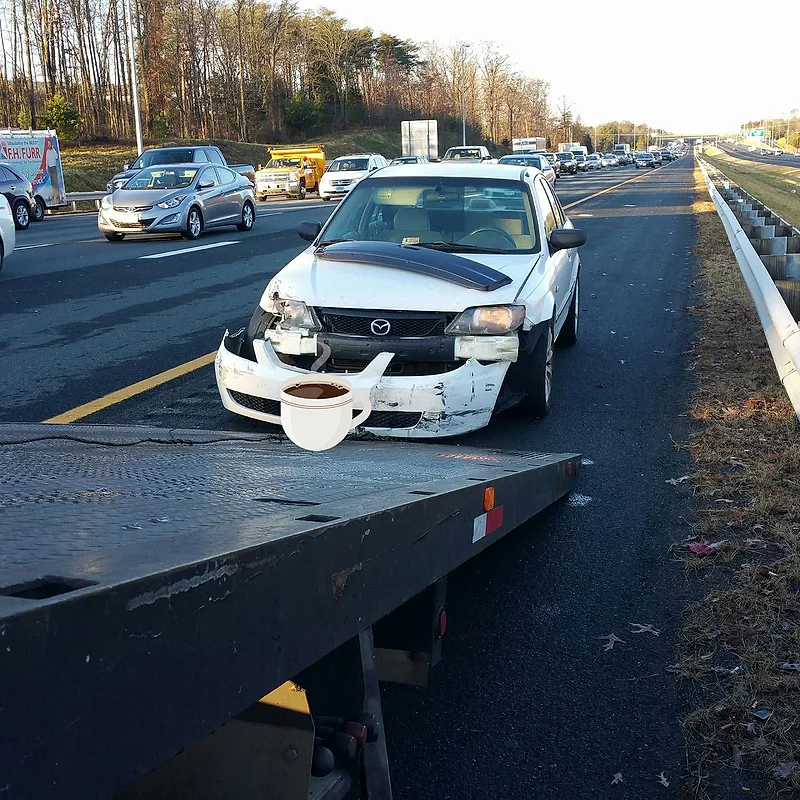
Ask for the price before the truck is sent. A damaged car often goes on a flatbed so no wheels touch the road. For the steps to take at the scene itself, read what to do after a car accident in Virginia.
Frequently asked questions
Does insurance cover towing after an accident? Often, yes, but it depends on fault and your coverage. The at-fault driver’s liability insurance may pay, and your own collision or towing coverage may pay too. Check your policy and talk to your insurer.
Do I have to pay the tow company right away? Usually, yes. Most drivers pay at the time of service or when they pick up the car, then submit the receipt to the insurance company for reimbursement.
Can I choose my own body shop? In general, yes. Your insurer may suggest a shop, but you can usually ask to have the car towed to the one you prefer. Check with your insurer about how that affects your claim.
Do I need to move my car after a minor crash? If no one is hurt and the car can be driven safely, Code of Virginia § 46.2-888 generally says to move it out of the travel lanes. If it can’t be driven safely, leave it, turn on your hazards and call for a tow.
Do I need to report the crash to the police? Virginia requires certain crashes to be reported to the police, such as those with injuries. If anyone is hurt or you’re not sure, call the police. A police report number also helps with your insurance claim.
Accident towing in Norfolk and Hampton Roads
All Wide Towing & Recovery provides accident towing and flatbed towing from our base in Norfolk. We tow across Norfolk, Virginia Beach, Chesapeake, Portsmouth, Suffolk, Hampton and Newport News, and we’re open every day, day and night.
Call (757) 796-4622 or contact us with your location, your vehicle and where it should go. You’ll get an itemized receipt to submit to your insurance company. Have more questions? Visit our FAQ page.
This is general information, not legal or insurance advice.
Need a tow in Norfolk?
Last updated: