Car Broke Down on I-64 or I-264 in Norfolk? What to Do
If your car breaks down on I-64, I-264 or another Norfolk interstate, get to the right shoulder or the next exit, turn on your hazard lights, stay buckled in, and call a tow truck with your exact location. Here is each step, plus what to do on a bridge or in a tunnel.
Quick answer
- Steer to the right shoulder, or take the next exit if you can reach it safely.
- Turn on your hazard lights right away.
- Stay in the car with your seat belt on unless you smell smoke or see fire.
- Note the interstate, your direction and the nearest exit or mile marker.
- In a tunnel or on a bridge, stay put and dial #77 on a cell phone to reach the Virginia State Police.
- Call a tow truck once you know where you are: All Wide Towing & Recovery, (757) 796-4622.
What should I do first if my car breaks down on the interstate?
Get out of the travel lanes. That one step matters more than anything else you do. As soon as something feels wrong, such as a warning light, a loss of power, a thumping tire or steam from under the hood, signal and work your way to the right.
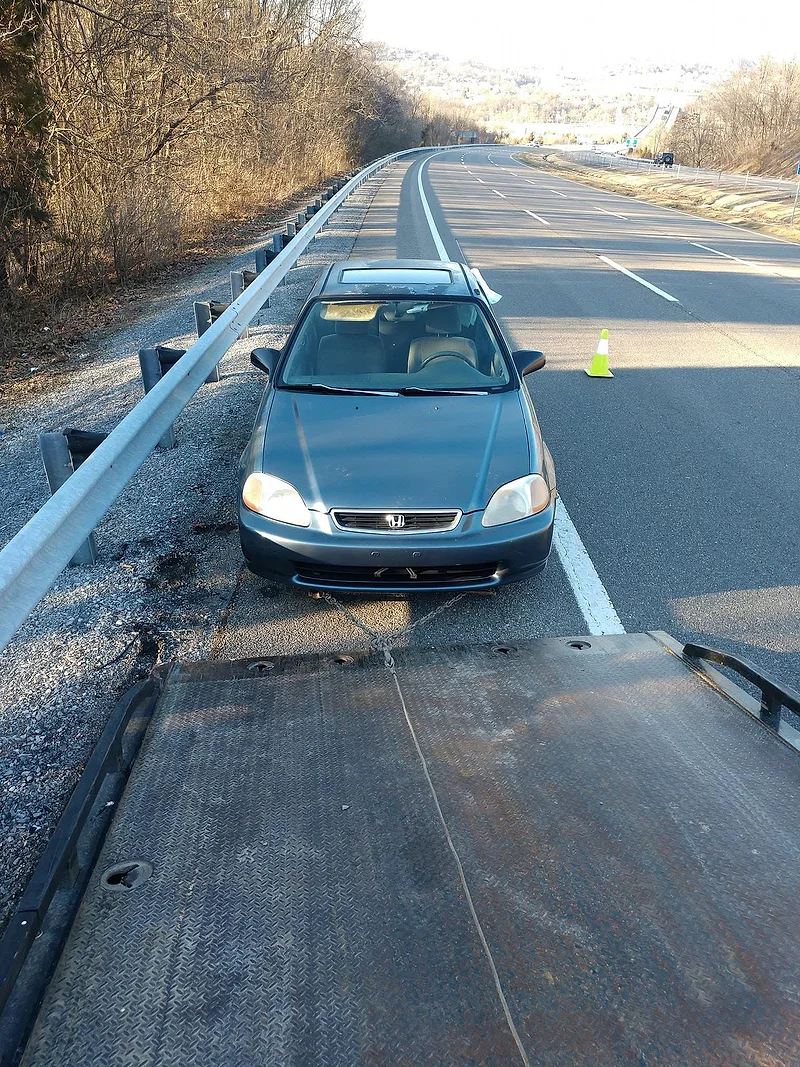
If you can reach an exit, take it. A side street, gas station or parking lot is far safer than any interstate shoulder. If you can’t make it, stop as far right as you can, on level ground if possible, and turn your front wheels away from traffic.
Avoid the left median when you have a choice. Traffic on I-64 and I-264 moves fast, and a car stopped on the left side is harder to reach safely.
Why do hazard lights matter in Virginia?
Hazard lights make you visible, and in Virginia they also put the Move Over law on your side. Under Code of Virginia § 46.2-861.1, drivers approaching a stopped vehicle that shows hazard lights, flares or caution signs must move to a lane that isn’t next to it when that’s reasonable, or slow down and pass with caution.
Turn them on the moment you start slowing down, and leave them on until your car is loaded. Only set out warning triangles if you can do it without stepping near moving traffic.
Should I stay in my car or get out?
On an interstate shoulder, the safest place is usually inside your vehicle with your seat belt fastened. If a passing driver drifts onto the shoulder, the belt protects you.
Get out only if you smell smoke, see fire, or there’s a clearly safer place to stand. Exit on the side away from traffic, move well back from the road or behind a guardrail, and keep children and pets with you. Never try to cross the interstate on foot.
What if I break down in a tunnel or on a bridge?
Stay in your vehicle with your hazard lights on and dial #77 on a cell phone to reach the Virginia State Police. This applies in the Hampton Roads Bridge-Tunnel, the Monitor-Merrimac Memorial Bridge-Tunnel, and the Downtown and Midtown tunnels. Don’t walk inside a tunnel or along a bridge.
Breakdowns inside those crossings are handled by the authorities who run them. Once your vehicle has been moved to a safe spot, call us at (757) 796-4622 and we’ll tow it from there to a shop or your home.
Before a long drive, check 511, VDOT’s traveler information line, for lane and tunnel closures on I-64, I-264 and I-664.
How do I tell a tow dispatcher where I am on the interstate?
Interstates don’t have street addresses, so give the dispatcher landmarks they can find. Have these ready before you call:
- The road: I-64, I-264, I-464, I-564 or I-664
- Your direction: eastbound, westbound, northbound or southbound
- The last exit you passed or the next one ahead, plus any mile marker sign you can see
- Which side you’re on: the right shoulder, the median or a ramp
- Nearby landmarks, such as an overpass, a bridge or a business sign
If your phone has a map app, open it and read off the nearest cross street, or share your location by text.
What else should I tell the tow company?
Tell the dispatcher what you’re driving and what happened, so the right truck comes the first time.
- Year, make, model and color
- Whether it’s all-wheel drive, four-wheel drive, electric or lowered, since those often need a flatbed
- What went wrong: won’t start, flat tire, overheating or crash damage
- Where the car should go, with the shop’s name and address
- A phone number that will stay free for a callback
Ask for the price before the truck is sent, so there are no surprises.
Do I need a tow, or just roadside assistance?
You may not need a tow at all. A dead battery, a flat with a usable spare or an empty tank can often be handled where you are with a jump start, a tire change or fuel delivery.
On some busy interstates, VDOT’s Safety Service Patrol may stop to help with minor problems. If your car needs to go to a shop or home, you’ll still need a tow truck.
What should I do while I wait?
Keep your hazard lights on, your seat belt fastened and your phone free. Don’t try repairs on the traffic side of the car. Keep your registration, driver’s license and insurance card within reach.
If a police officer gives you instructions, follow them. When the tow truck arrives, check that the company name on the door matches the one you called.
Need a tow truck near you in Hampton Roads?
If your car broke down on the interstate anywhere in Hampton Roads, call All Wide Towing & Recovery at (757) 796-4622. We’re based in Norfolk and tow cars, SUVs, pickups and vans across Norfolk, Virginia Beach, Chesapeake, Portsmouth, Suffolk, Hampton and Newport News. We’re open every day, day and night.
Need a tow in Norfolk?
Last updated: