What to Do After a Car Accident in Virginia
After a car accident in Virginia, check for injuries and call the police if anyone is hurt, turn on your hazard lights, move drivable cars out of the travel lanes if no one is hurt, exchange information, document the scene, and arrange a tow for any car that can’t be driven safely.
Quick answer
- Check everyone for injuries. If anyone is hurt, call the police and ask for medical help.
- Turn on your hazard lights.
- If no one is hurt and the cars can be driven, move them out of the travel lanes (Code of Virginia § 46.2-888).
- Exchange names, phone numbers, license, plate and insurance details.
- Take photos and get witness contacts.
- Call a tow truck for any car that can’t be driven safely.
- Report the crash to your insurance company.
What should you do right after a car accident?
Stop, stay calm and check for injuries before anything else.
Check yourself and your passengers, then the people in the other vehicle if you can reach them safely. If anyone is hurt, call the police right away and ask for medical help. Don’t move an injured person unless they’re in immediate danger, such as from fire.
Turn on your hazard lights so approaching drivers see you. They also bring Virginia’s Move Over law, § 46.2-861.1, into play: drivers coming up behind you must move over or slow down.
Do you have to move your car after an accident in Virginia?
If no one is hurt or killed and your car can be moved safely, yes. Virginia’s “move it” law, Code of Virginia § 46.2-888, says to move it out of the travel lanes.
The law allows you to stop in a way that blocks traffic only for an emergency, a crash or a breakdown, and then you must turn on your flashers. Report the vehicle’s location to the nearest police officer as soon as practical, and move it off the shoulder without unnecessary delay. If a vehicle left in place creates a hazard, an officer can order it removed at the owner’s expense.
Moving a minor fender-bender to the shoulder or a nearby parking lot helps prevent a second crash, a real risk on busy roads like I-64, I-264 and I-464.
When should you call the police after a crash?
Call the police whenever anyone is hurt, a vehicle can’t be moved, or there’s significant damage. On an interstate, dial #77 on a cell phone to reach the Virginia State Police. On city streets, call the local police.
An officer can document the scene, which helps with your insurance claim. If police come, follow their instructions about moving the vehicles and ask how to get a copy of the crash report.
Drivers can also file a crash report with the Virginia DMV using form FR200. Check the DMV’s crash reporting page for the current steps.
What information should you exchange after an accident?
Exchange the basics with every driver involved, and stay polite and factual.
- Full name and phone number
- Driver’s license number
- License plate number and state
- Insurance company and policy number
- Make, model and color of the vehicle
- The owner’s name, if the driver doesn’t own the car
Talk about facts, not fault. Leave fault to the police and the insurance companies.
How should you document the accident scene?
Photos taken in the first few minutes are hard to recreate later, so take them before the cars are towed, as long as it’s safe.
- All vehicles from several angles, plus close-ups of the damage and the plates
- The road, lane markings, signs, signals and weather
- Skid marks and debris
- Names and phone numbers of any witnesses
- The time and exact location, including the interstate, direction and nearest exit
Never stand in a travel lane to take a photo.
What if the crash happens on a bridge or in a tunnel?
Stay in your vehicle with your seat belt fastened and your hazards on, and dial #77 on a cell phone to reach the Virginia State Police. This applies in the Hampton Roads Bridge-Tunnel, the Monitor-Merrimac Memorial Bridge-Tunnel, and the Downtown and Midtown tunnels.
Don’t walk around inside a tunnel or along a bridge. Once the vehicles have been moved to a safe spot, call us for the tow.
How do you get your car towed after an accident?
If your car can’t be driven safely, call a tow truck and tell the dispatcher it’s an accident tow.
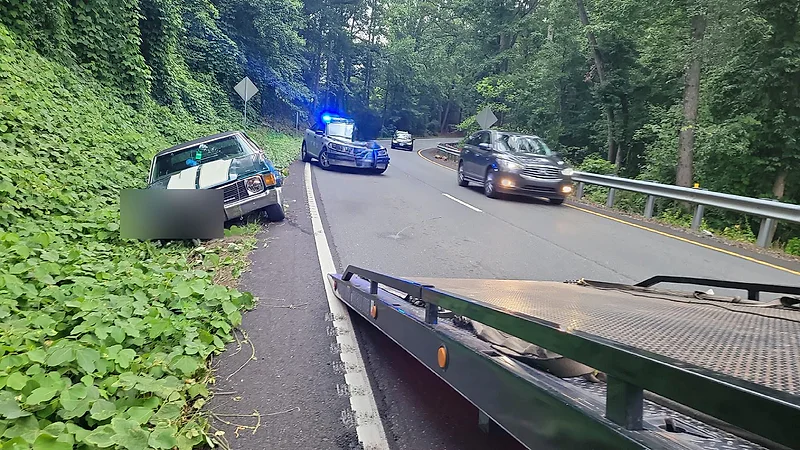
Signs a car shouldn’t be driven include leaking fluids, a damaged wheel or tire, deployed airbags, broken headlights or taillights, and a hood that won’t latch. A damaged vehicle usually goes on a flatbed so no wheels touch the road.
Give the dispatcher your location, your vehicle, the damage and where it should go: a body shop you choose, your insurance company’s chosen shop, or your home. Ask for the price before the truck is sent, and keep the receipt.
When should you call your insurance company?
Report the accident to your insurer as soon as you can, ideally the same day.
Have your photos, the other driver’s details, the police report number if there is one, and your towing receipt ready. Ask your insurer whether your policy covers towing and where they want the car inspected.
Accident towing in Norfolk and Hampton Roads
All Wide Towing & Recovery provides accident towing from our base in Norfolk to drivers in Norfolk, Virginia Beach, Chesapeake, Portsmouth, Suffolk, Hampton and Newport News. We’re open every day, day and night. Call (757) 796-4622.
Need a tow in Norfolk?
Last updated: