Virginia’s Move Over Law Explained (§ 46.2-861.1)
Virginia’s Move Over law, Code of Virginia § 46.2-861.1, requires drivers approaching a stopped vehicle that is showing flashing lights, hazard lights, flares or caution signs to move to a lane that isn’t next to it when that’s reasonable, or to slow down and pass with caution.
Quick answer
- The law: Code of Virginia § 46.2-861.1.
- It covers stopped vehicles showing flashing blue, red or amber lights, such as police cars, fire trucks, ambulances and tow trucks.
- It also covers any stopped vehicle with its hazard lights on, caution signs out or flares lit.
- On a highway with four or more lanes, at least two in your direction, move to a lane that isn’t next to the stopped vehicle if it’s reasonable.
- If you can’t move over safely, slow down and pass with caution.
- Breaking the law can mean a reckless driving charge or a traffic infraction, and a possible license suspension.
What does Virginia’s Move Over law require?
The law asks two things of you: move over if you reasonably can, and slow down if you can’t.
On a highway with at least four lanes and at least two going your direction, such as I-64, I-264 or I-664, you must move into a lane that isn’t next to the stopped vehicle, as long as it’s reasonable to do so.
If traffic, weather or the road layout makes a lane change unsafe, or there’s no lane to move into, you must slow down and proceed with caution as you pass. Ease off early and give the stopped vehicle as much room as you safely can.
Which vehicles does the Move Over law protect?
It protects anyone stopped at the roadside with warning lights, hazard lights, flares or caution signs, not only police.
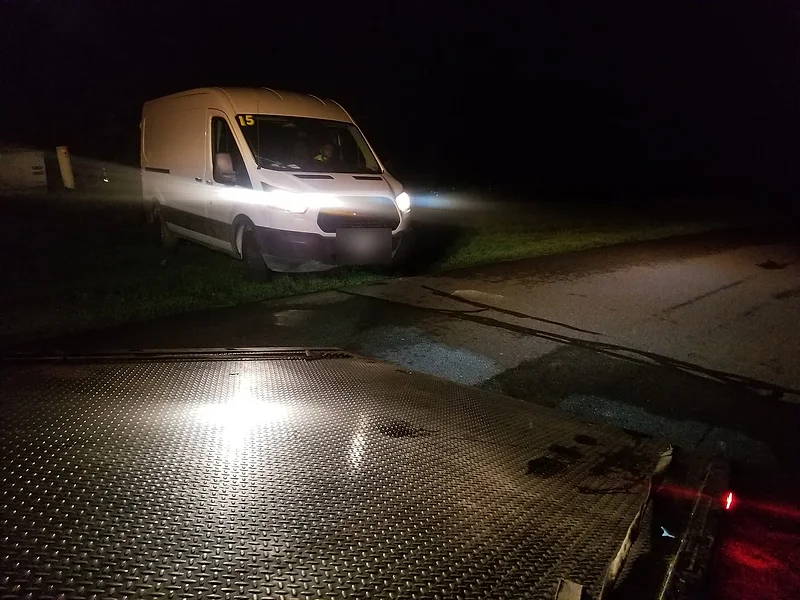
The statute covers stationary vehicles displaying flashing blue, red or amber lights. That includes police cars, fire trucks, ambulances and tow trucks working at the roadside. It also covers any stopped vehicle with its hazard lights on, caution signs out, or lit flares or torches.
That second part matters to everyday drivers. If your car breaks down on the shoulder of I-264 and you switch on your hazards, the drivers coming up behind you are required to move over or slow down for you, too.
What happens if you don’t move over in Virginia?
Failing to move over or slow down is a real violation, not just bad manners. Under § 46.2-861.1, unlawfully passing a stopped vehicle with flashing emergency lights counts as reckless driving. Unlawfully passing a vehicle showing hazard lights, flares or caution signs is a traffic infraction.
If a violation leads to property damage, a court can suspend the driver’s license for up to one year. If it leads to someone being hurt or killed, the suspension can be up to two years.
One exception: the Move Over law does not apply in highway work zones. Follow the posted signs and speed limits there.
Is § 46.2-921.1 still the Move Over law?
No. Older articles cite Code of Virginia § 46.2-921.1, but that section was repealed in 2019. The current Move Over law is § 46.2-861.1.
How do you move over safely?
Plan early so the lane change is smooth, not sudden.
- Scan far ahead for flashing lights, hazard lights and flares, especially at night and in rain.
- Check your mirrors and blind spot, signal, then change lanes smoothly.
- If you can’t move over, slow down well below the speed limit and give as much room as you can.
- Don’t brake hard or swerve at the last second. That can cause the crash you’re trying to avoid.
- Put the phone down. A glance at a screen is enough to miss a stopped car.
What should you do if you’re the one stopped on the shoulder?
Turn on your hazard lights first. They make you visible and bring the Move Over law into play.
Then stay in your car with your seat belt on, unless you smell smoke or see fire. If you have to get out, exit on the side away from traffic and stand well back from the road, behind a guardrail if there is one.
If you’re stopped on a bridge or in a tunnel, such as the Hampton Roads Bridge-Tunnel, the Monitor-Merrimac Memorial Bridge-Tunnel, or the Downtown or Midtown tunnels, stay in your vehicle with your hazards on and dial #77 on a cell phone to reach the Virginia State Police. Once the vehicle has been moved to a safe spot, call a tow company.
If you pass a stopped car and aren’t sure the driver is safe, pull over somewhere safe yourself and dial #77 to tell the State Police where it is.
Why does the Move Over law matter to tow operators?
Tow truck drivers work a few feet from moving traffic on roadside calls. When you see amber lights and a tow truck loading a car on I-64 or I-464, moving over gives the operator and the stranded driver room to finish the job safely. The same goes for a family stopped with a flat tire on the shoulder of I-564. We ask every driver who passes a roadside stop to give it room.
Need a tow in Norfolk or Hampton Roads?
If you’re stopped at the roadside, turn on your hazards, stay buckled in, and call All Wide Towing & Recovery at (757) 796-4622. We’re based in Norfolk and help drivers across Norfolk, Virginia Beach, Chesapeake, Portsmouth, Suffolk, Hampton and Newport News. We’re open every day, day and night.
Need a tow in Norfolk?
Last updated: